
Sunday, January 26, 2014
Yale and Darwin
Rev. Merrill Richardson, Yale 1839: "The development theory of Darwin, Huxley, Owen, and others of that school was shown by their own standards to be without foundation in fact or science."

Tuesday, January 21, 2014
Hispanics: Remapping The Territory
Tracing the "Hispanic" history of the United States is even more complicated than Felipe Fernandez-Armesto, author of Our America, may realize. One of the most significant soldier-administrators for northern Mexico was in fact Irish. Hugo Oconor (Hugh O'Conor), "The Red Captain", stabilized the northern territory of Mexico by among other measures establishing garrisons near Tucson and San Antonio to defend against raids by Native American tribes, e.g., the Apache. In other words, Tucson was established to keep the Apaches and other Native-Americans out of Mexico. While the Spanish are often simplistically viewed as conquerors, they viewed themselves as coming to America not only for fortune, but also to save souls and protect native peoples from famine and predation by other tribes, the Apache and Aztecs being the most fierce predators.
The real heroes of the Mexican-American war (the American War to establish slavery in Texas) were the Irish-Catholic soldiers who deserted the U.S. Army to fight for Mexico as the San Patricio Brigade. Fifty of the Irish soldiers were hanged after the American victory, one of the darkest moments in American history.
In a better moment, Grant sent Phil Sheridan, his fierce little Irish general who had stormed Missionary Ridge, and thousands of African-American soldiers of the XXV Corps, which closed the trap on Robert E. Lee at Appomattox, to the Rio Grande to help Benito Juarez drive the French out of Mexico. Sheridan left guns and ammunition on the Rio Grande for Juarez, and then allowed his soldiers to "resign" and "volunteer" to serve with the Mexicans fighting the French. The US army volunteers were "designated the American Legion of Honor." As many as 3,000 American war veterans fought for the Mexican Republic and possibly 2,000 Confederate veterans sided with the Mexican forces aligned with the French.
The North's greatest Hispanic general, of course, was George Gordon Meade, who defeated Robert E. Lee at Gettysburg.
http://hidden-civil-war.blogspot.com/2013/08/the-norths-greatest-hispanic-general.html
Only Carlos Fuentes and Cervantes have explored the ancient roots of the Hispanics, Numantia, and the stormy marriage, some might call it rape, of Celtic Spain with Rome.
* * * * *
San Xavier del Bac.
August 20, 1775
"I, Hugo Oconor, knight of the order of Calatrava, colonel of infantry in His Majesty's armies and commandant inspector of the frontier posts of New Spain
Certify that having conducted the exploration prescribed in Article three of the New Royal Regulation of Presidios issued by His Majesty on the tenth of September 1772 for the moving of the company of San Ignacio de Tubac in the Province of Sonora, I selected and marked out in the presence of Father Francisco Garces and Lieutenant Juan de Carmona a place known as San Agustin del Tucson as the new site of the Presidio. It is situated at a distance of eighteen leagues from Tubac, fulfills the requirements of water, pasture, and wood and effectively closes the Apache frontier. The designation of the New Presidio becomes official with the signatures of myself, Father Francisco Garces, and Lieutenant Juan de Carmona, at this mission of San Xavier del Bac, on this twentieth day of August of the year 1775."
Hugo Oconor
Fray Francisco Garces
Juan Fernandez Carmona
Friday, January 17, 2014
Tammany Heroes: Wagner and Gavagan
Bob Wagner was born an ordinary German, married Irish and was buried Catholic. He fathered Social Security, the National Labor Relations Act, giving workers the right to organize and a mayor who championed fair housing, minority hiring and the City University. Very much the Wagners' work reflected the Papal Encyclical Rerum Novarm concerning social responsibility and justice.
Wagner also lobbied for rescuing Jewish children from Hitler and the Tuskegee Airmen's right to fly, and along with Harlem Congressman Joseph Gavagan and their NAACP ally Walter White waged a determined but ultimately futile campaign to pass anti-lynching legislation.
My grandfather was proud to call them friend and to have convinced Wagner to run for the US Senate.
Tuesday, January 14, 2014
Anglo-German Exceptionalism
Rev. Merrill Richardson, Yale 1839: "Our fathers belonged to that conquering race.... They are the same Cythians still, in their venturous and indomitable spirit... It has been said that the Saxon race has cut off the heads of more Kings than all other races....In coming to New-England the Pilgrims struck good soil. The soil and the climate are not far different from the homes of their Cythian forefathers.... Sounder minds were never seen in sounder bodies and stronger hearts than theirs.... the people were intelligent; they were the people who composed Cromwell's Ironsides... the men who Macauley and Carlye declared established the liberties of Englishmen.... we would fulfill the mission of our noble ancestors and accomplish the task designed for them by the Almighty.

The New York Times
Published: May 9, 1870
Thursday, January 2, 2014
Meade's Pursuit of Lee
It's an egregious allegation to make by saying Meade did not follow Lee's army after Gettysburg. In fact Meade did follow Lee and came very close to trapping him at the Potomac on July 13-14. It was only through a remarkable feat of bridge building and falling water levels in the river that Lee was able to escape prior to Meade's attack scheduled for the 14th. Meade's pursuit was remarkably effective given that he was under orders to protect Washington and Baltimore and had to move by forced marches on the east side of the South Mountain. Lee executed a very competent withdrawal. He never gave battle without a pre-planned and defendable line of retreat, the Shenandoah-Cumberland Valley being one of the best avenues of attack and retreat on the continent.
Recall that Grant failed to trap Bragg after the victory at Missionary Ridge, and that it took over eight months for Grant to bring Lee to bay at Appomattox. His Vicksburg campaign took six months. Grant captured the garrison, which never attempted an escape, and then paroled it. A few months later he found himself fighting the same troops at Chattanooga. Sherman's Atlanta campaign took four months and at the end of it he captured Atlanta, but failed to destroy the Confederate Army of the Tennessee.
Complaints about Meade and McClellan are really apologies for the first Republican administration to sell the American people a war that would be far more difficult to win than advertised. An added dimension in the case of Meade is that the Irish-Catholic was unacceptable as a hero for many Republicans who were Nativists and rabid anti-Catholics like the Beechers.
Tuesday, December 10, 2013
Best Friend of Charleston: Ironclads, Artillery and Locomotives
No they never taught us what was real
Iron and coke and chromium steel.
Most of the discussion of Civil War gunboats and ships takes naval artillery for granted and leaves artillery almost completely out of the analysis, emphasizing armoring of the ships. From personal experience you want be on the side of the battle with biggest most accurate guns. These take time to produce and require a sophisticated and robust industry to produce them. The Confederate boats and batteries had to make do with 12- and 24-pounder artillery and some 32-pounders, most of which (1200) were captured at Gosport early in the war. The Union was in the process of replacing its 32-pound naval guns when the war began. It had lots of them to spare for the gunboats. When the war started the Union had been manufacturing larger replacement guns for years, beginning in the mid 1850s, and had a significant capacity for manufacturing more of them (Alger Foundry, West Point Foundry, Seyfert & McManus, Fort Pitt Foundry). Union gunboats, for example mounted two to four 8-inch guns (62 pounders), two to six 32-pounders, and two to six 42-pounders. By 1863 and the Vicksburg campaign Union gunboats like the USS Carondelet would carry three 9-inch guns, four 8-inch guns, a 50-pound rifle, 32-pounders and 42-pounders. By 1864, two 100-pound rifles were added. Even in the case of the British built Confederate raiders, the Union had a fire power advantage. In the famed sea battle between the USS Kearsarge and CSS Alabama, the Kearsarge mounted two 11-inch Dahlgren pivot guns firing 140-pound shot compared to the Alabama's single 100-pounder and single 68-pounder. In other words, the Union's artillery manufacturing capability meant the Confederates were completely outgunned on the Mississippi and at sea.
The irony of this military advantage was that slavery helped build it. An analysis of the West Point Foundry's production for civilian buyers shows that much of it was destined for the South, including the first locomotive entirely produced in the United States, Best Friend of Charleston. Prior to the outbreak of Civil War hostilities, the West Point Foundry had produced the huge Dahlgren guns mounted on the USS Monitor.

"I saw it standing forlorn and lost, in disrepair, high on its rock overlooking our beloved Hudson and I nearly wept at the sight."-- Helen Hayes, 1971

For those [Irish immigrants] who gained employment at the West Point Foundry in Cold Spring, a chapel was established to serve them and their families. Foundry owner Gouverneur Kemble donated land and funds for what would be the first Catholic church north of Manhattan.
Iron and coke and chromium steel.
Most of the discussion of Civil War gunboats and ships takes naval artillery for granted and leaves artillery almost completely out of the analysis, emphasizing armoring of the ships. From personal experience you want be on the side of the battle with biggest most accurate guns. These take time to produce and require a sophisticated and robust industry to produce them. The Confederate boats and batteries had to make do with 12- and 24-pounder artillery and some 32-pounders, most of which (1200) were captured at Gosport early in the war. The Union was in the process of replacing its 32-pound naval guns when the war began. It had lots of them to spare for the gunboats. When the war started the Union had been manufacturing larger replacement guns for years, beginning in the mid 1850s, and had a significant capacity for manufacturing more of them (Alger Foundry, West Point Foundry, Seyfert & McManus, Fort Pitt Foundry). Union gunboats, for example mounted two to four 8-inch guns (62 pounders), two to six 32-pounders, and two to six 42-pounders. By 1863 and the Vicksburg campaign Union gunboats like the USS Carondelet would carry three 9-inch guns, four 8-inch guns, a 50-pound rifle, 32-pounders and 42-pounders. By 1864, two 100-pound rifles were added. Even in the case of the British built Confederate raiders, the Union had a fire power advantage. In the famed sea battle between the USS Kearsarge and CSS Alabama, the Kearsarge mounted two 11-inch Dahlgren pivot guns firing 140-pound shot compared to the Alabama's single 100-pounder and single 68-pounder. In other words, the Union's artillery manufacturing capability meant the Confederates were completely outgunned on the Mississippi and at sea.
The irony of this military advantage was that slavery helped build it. An analysis of the West Point Foundry's production for civilian buyers shows that much of it was destined for the South, including the first locomotive entirely produced in the United States, Best Friend of Charleston. Prior to the outbreak of Civil War hostilities, the West Point Foundry had produced the huge Dahlgren guns mounted on the USS Monitor.
"I saw it standing forlorn and lost, in disrepair, high on its rock overlooking our beloved Hudson and I nearly wept at the sight."-- Helen Hayes, 1971
For those [Irish immigrants] who gained employment at the West Point Foundry in Cold Spring, a chapel was established to serve them and their families. Foundry owner Gouverneur Kemble donated land and funds for what would be the first Catholic church north of Manhattan.
Friday, November 29, 2013
A Treasure Trove of New York City Battle Flags and Medals
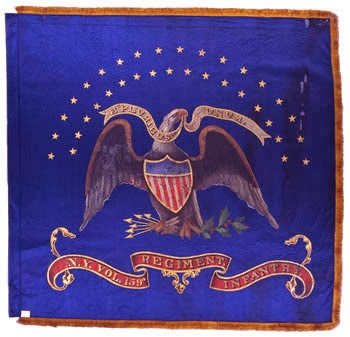
116 infantry regiments and artillery batteries, with over 150,000 soldiers, were organized at New York City during the Civil War, not including dozens of militia units mobilized to defend Washington during the war's early days and Harrisburg during Lee's invasion of Pennsylvania. These are the battle and regimental flags for some of the New York City units: source New York State Military Museum. |
| 16th New York Cavalry Led by Capt. Edward Doherty Hunted down and killed John Wilkes Booth |

69th NY - Irish Brigade
The Fighting Irish
Bull Run, Malvern Hill, Antietam, Fredericksburg, Chancellorsville, Gettysburg, The Wilderness, Spotsylvania, Cold Harbor, Petersburg, Appomattox, where Grant sent the first demand for Lee to surrender through its lines.
At Antietam's Bloody Lane, eight of its color bearers were successively shot down during the assault that broke the Confederate center.

71st New York - Excelsior Brigade

73rd NY - Excelsior Brigade
“Over four hundred voted for a Catholic priest, one hundred and fifty-four, for any kind of a protestant minister; eleven, for a Mormon elder; and three hundred and thirty-five said they could find their way to hell without the assistance of clergy.”
-- Father Joseph O'Hagan, SJ on how he was chosen regimental chaplain

74th NY - Fifth Excelsior Brigade

NYC's DeKalb German Regiment

37th NY
Irish Rifles

63rd NY
Irish Brigade

Irish Brigade Battle Flag
Suffered casualties so severe throughout the war that the brigade had to be resurrected twice with new recruits and men who had recovered from their wounds.


Army Medal of Honor - NYC 120+

Navy Medal of Honor - NYC 80+

40th NY - Mozart Hall
formed around a cadre of Irishmen who weren't allowed to enlist in Boston

42nd NY - Tammany Hall
Led by Irish-American Col. James Mallon, the 42nd led the repulse of Pickett's Charge at Gettysburg

1st NY Cavalry
Dickel's German Mounted Rifles
Organized at New York by Carl Schurz

The 1st NY led the breakout of Milroy's survivors from Winchester. Harried and monitored Lee's vanguard as it marched into Pennsylvania in 1863, providing invaluable intelligence to the Union high command.

5th NY Cavalry
"Burning all the buildings within 5 miles of Dayton [Shenandoah Valley]. Burning in retaliation for Lieut. Shot last Evg. by a bushwhacker. Terrible sorry sight see to all buildings burning & women crying." -- Van Dusen Diary

6th NY Cavalry
Fought with Buford's Division on the morning of the first day at Gettysburg.

5th NY Infantry
Duryee's Zouves
Organized by the scion of NYC French soldier who fought with Washington in the Revolution

31st Infantry, US Colored Troops
The 31st was one of three "colored" regiments organized at New York City (along with the 20th and 26th). It was part of the powerful African-American XXV Corps, which closed the trap on Robert E. Lee at Appomattox.

Mozart (40th NY) and Scott Life Guard (38th NY)
Taking Possession of the Red Redoubt at Petersburg

39th NY
Garibaldi Guard: Italian, Dutch, Polish and Hungarian Legion

46th NY
Fremont [German] Rifles
Fought at Antietam and the sieges of Vicksburg and Petersburg

48th NY
Continental Guards
Severe casualties at Ft. Wagner, SC, and Olustee, Florida

51st NY
Shepard Rifles
Led by Italian and French New Yorkers: Edward Ferrero and Charles Legendre
Fought at Antietam, Vicksburg, Wilderness, Petersburg

52nd NY
Sigel's Rifles
In the fighting at Spotsylvania's Bloody Angle, the 52nd lost the Prussians Count Van Haake and Baron Von Stueben.
 59th NY
Union Guards
 61st Regiment
Astor Rifles
 65th NY
United States Chasseurs
"In reply to the circular [of 1/21/1863], I have addressed the Adjutant-General of the State or New-York, and informed him that the tattered flag of my regiment -- mere rags -- under which my command has so often, so gallantly and so successfully fought -- within sight of which, and cheered and animated by it, hundreds have fallen -- is not the property of the State of New-York; it belongs to the City of New-York. It was given to us by her Common Council, and cannot be disposed of without their consent and approval. "
-- J. Egbert Farnham, Col. 70th NY, Excelsior Brigade
 72nd NY - Excelsior Brigade

52nd NY
Sigel's Rifles
In the fighting at Spotsylvania's Bloody Angle, the 52nd lost the Prussians Count Van Haake and Baron Von Stueben.
Union Guards

Astor Rifles

United States Chasseurs
"In reply to the circular [of 1/21/1863], I have addressed the Adjutant-General of the State or New-York, and informed him that the tattered flag of my regiment -- mere rags -- under which my command has so often, so gallantly and so successfully fought -- within sight of which, and cheered and animated by it, hundreds have fallen -- is not the property of the State of New-York; it belongs to the City of New-York. It was given to us by her Common Council, and cannot be disposed of without their consent and approval. "
-- J. Egbert Farnham, Col. 70th NY, Excelsior Brigade

Highlanders
New York's Scots regiment. Probably the source for the nickname the baseball Yankees used before deciding on a more ecumenical one.

Organized initially as the 2nd Militia, the 82nd suffered severe losses at Antietam and Gettysburg.

The 9th NYS Militia was mustered into service as the 83rd NY Volunteers. It suffered heavy casualties at Antietam, Fredericksburg, the Wilderness and Spotsylvania.

84th NY
The 14th NYS Militia from Brooklyn was mustered into Union service as the 84th NY Volunteers after hard fighting at First Bull Run and became part of the Eastern Iron Brigade. It is the only regiment with three Gettysburg monuments: at the Railroad Cut, McPherson's Ridge and Culp's hill. The 14th, as it liked to be known, carried General Reynolds body from the field during the retreat on the first day at Gettysburg.

Chaplain William Corby took the "Fighting Irish" nickname back to Notre Dame University where he became president.

Father William Corby at Gettysburg
Notre Dame Permanent Collection

First Regiment, Metropolitan Guard
Fought in Louisiana and the Seige of Port Hudson

Corcoran's Irish Legion
Spotsylvania, Cold Harbor, Petersburg and Appomattox
"On Sunday the 15th an attack was made at three different [points], one under Genl. Payne [Charles J. Paine] on the right, Col. Gerard in the centre & I do not know who had the left. We were repulsed with severe loss on our side & very small loss to the rebels. We were drawn off under cover of the night. They have now called for a storming party of one thousand men, each of whom is to receive a gold medal & promotion. They have got more men than the number called for. When the charge is to be made I cannot say." -- Letter, Frank Tiemann to father, Port Hudson, June 26/63.

Corcoran's Irish Legion
Spotsylvania, Cold Harbor, Petersburg and Appomattox

The Death of Colonel McMahon, Cold Harbor:
“Leading his men to assault the enemy’s works he daringly dashed ahead, and foremost, fighting with the National colors in one hand, was in the act of planting them upon the earthworks which entrenched the foe, when his body was pierced with six bullets by the Rebel sharpshooters.”
Yesterday afternoon the famous Corcoran Legion was formally received by their fellow-countrymen, and by the great mass of the citizens of New-York, as well as by several of the crack regiments of the New-York State National Guard.
To say that the entire reception was a grand success is simply to say what is ever said of the ceremonies of a similar character gotten up by our enthusiastic Irish citizens. The history of the Corcoran Legion was a noble one, not far behind its fellow, the Irish Brigade, and only differing from it by reason of its entering the field at a later period of the war's history; and it was but right that the Irishmen should manifest their appreciation of the services of the Legion, representing as they did the natives of the "green isle beyond the seas."
The Irish Legion assembled at the Centre Market Armory at 1 o'clock P.M. yesterday, and after forming, marched down to Grand-street, where they formed in line, right resting on Broadway, as follows:
The One Hundred and Fifty-fifth Regiment, Col. BYRNE.
The One Hundred and Seventieth Regiment, Major HAGAN.
The One Hundred and Sixty-fourth Regiment, Col. WM. DELACY.
The Sixty-ninth Regiment, Col. COONAN.
The brigade was under command of Brevet Brig. Gen. JAMES P. MCIVOR.
An escort of police, from the Fourteenth Precinct, was present, under Sergeant BROOKS...
As the procession passed down Broadway, it attracted great attention from those assembled, and the gallant legion was received all along the entire route of march with the greatest enthusiasm, and loud and continuous cheering.
-- New York Times, July 26/65
Subscribe to:
Posts (Atom)